Somewhere, an artist is making extraordinary work that the right person may never see.
Not because the work is not good enough.
Not because there is no collector who would want it.
And not because there is no hotel, designer, curator, or workspace where it could belong.
Sometimes, the two simply never find each other.
That is the gap Rasa Collective was created to explore.
Because perhaps the next important question in art is not:
Who is already known?
Perhaps it is: Who have we not seen yet?
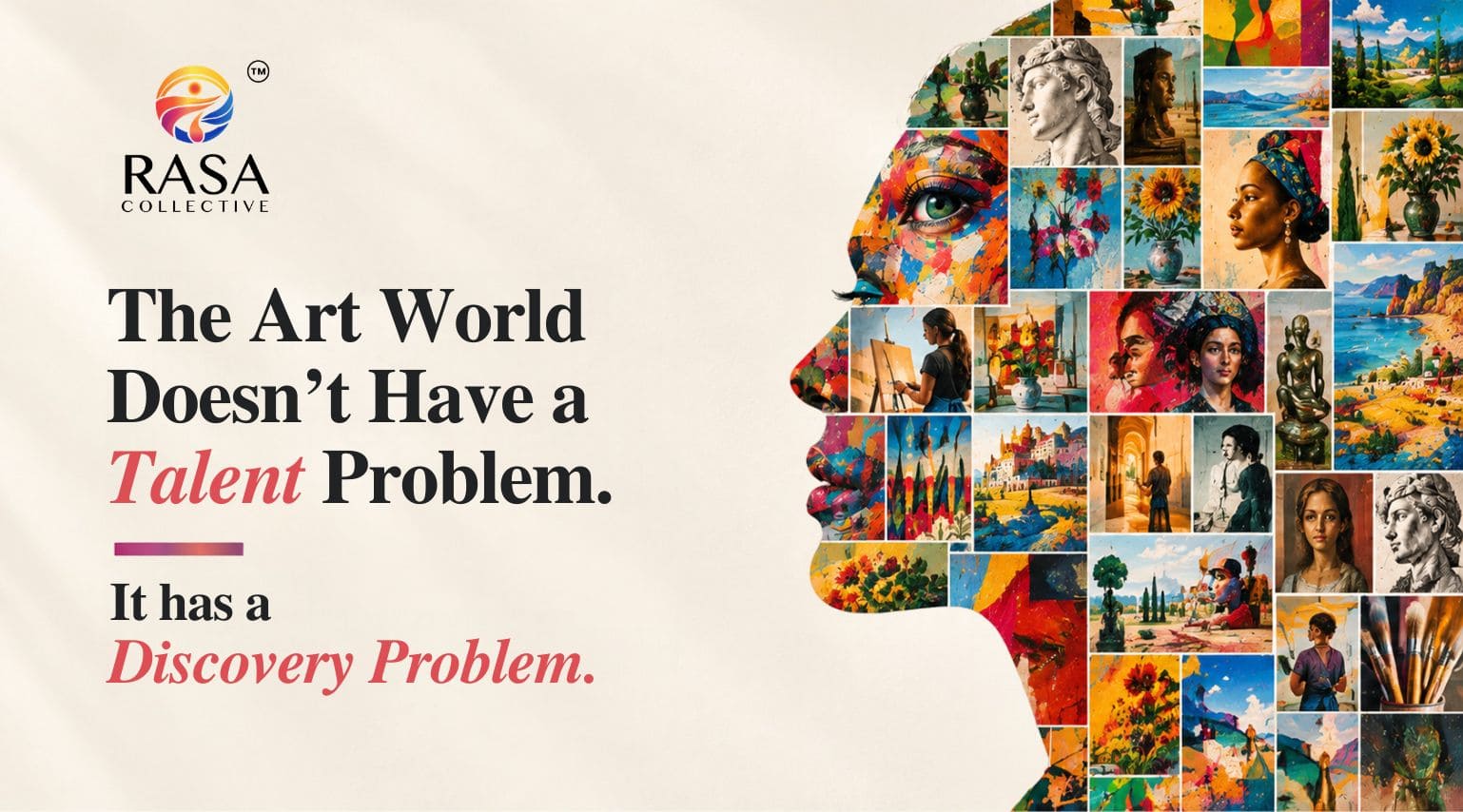
The world does not have an art shortage. It has a discovery problem.
There has never been more art within reach.
Open a browser. Visit a fair. Scroll through social media. Search an online art platform. Thousands of works can appear within minutes.
Yet access to more does not automatically mean discovery becomes better.
The global art market was worth an estimated $59.6 billion in 2025. At the same time, finding new buyers remained a priority across the dealer market, with 49% of buyers purchasing from a dealer being new to that business. Online channels remain particularly useful for introducing new buyers, even as more high-value transactions return to physical settings.
That tells us something interesting.
People are still looking.
Artists are still creating.
Buyers are still entering the market.
The challenge is what happens between creation and discovery.
Visibility is not the same as talent.
The art world has always had geography.
Certain cities become art capitals. Certain fairs become essential. Certain galleries build influence. Certain schools, networks, names, and neighborhoods become easier to notice.
Those systems have produced extraordinary careers.
But talent has never belonged exclusively to the places with the strongest art infrastructure.
An artist can build a serious practice in Mumbai, Accra, Lisbon, Lagos, Seoul, São Paulo, or a town most collectors have never searched by name.
The work does not become more meaningful when it enters a famous postcode.
It becomes more visible.
That distinction matters.
At Rasa, we believe art discovery should begin with the work, the practice, the perspective, and the story behind it, not simply with how close an artist already stands to the traditional centers of attention.
What if discovery started somewhere else?
Imagine you are looking for art for a boutique hotel.
You could begin with the names you already know.
Or you could begin with the place.
What should a guest feel when they enter?
What story belongs in this space?
What perspectives could make the property feel specific rather than interchangeable?
Now imagine you are a collector.
You may not be looking for the artist everyone else is already discussing. You may be looking for the piece that makes you stop.
Something you have not seen before.
Something that carries a point of view.
Something you want to live with.
That requires a different kind of art discovery platform.
Not an endless digital shelf.
A way of looking.
That is where Rasa begins.
Rasa Collective connects emerging artists with collectors, curators, hotels, designers, workspaces, and other people looking for original art with a reason to be there.
The idea is simple: Look further. Curate thoughtfully. Make discovery useful.
Rasa's growing network reaches artists across 42+ countries, creating opportunities to encounter practices beyond the same familiar circles.
But global reach alone is not the point.
The internet already gives us reach.
What matters is what we do with it.
More art is not necessarily better discovery.
Large digital art platforms have transformed access to art.
That is valuable.
But scale creates another challenge: choice.
When thousands or even millions of artworks are available, discovery can become another form of scrolling.
The person searching still has to answer:
What belongs here?
Why this artist?
Why this work?
What am I actually looking at?
This is where curation becomes more valuable, not less.
For Rasa, curation is not about deciding what everyone should like.
It is about creating enough context for the right work and the right person to recognize each other.
That may mean a collector finding an artist they would never have searched for.
An interior designer finding a piece that changes the direction of a room.
A hotel discovering work that gives a property a stronger sense of place.
Or an artist reaching an audience that previously sat several networks away.
Good curation does not narrow the world. It helps us see more of it.
For artists, discovery should mean more than being listed.
There is an important difference between being online and being seen.
Artists today can create a website, open a social account, upload a portfolio, or join a marketplace.
But presence alone does not create meaningful visibility.
For an emerging artist, the more important questions are:
Who is encountering the work?
Do they understand the practice behind it?
Can the work reach collectors beyond the artist's existing network?
Could it be considered for a hospitality project, workspace, private collection, or commission?
Can discovery lead somewhere?
Rasa is interested in that last question.
The goal is not simply to give art another place to appear.
It is to help good work travel further.
For collectors, discovery should still feel like discovery.
There is something special about encountering an artist before their name becomes familiar.
Not because collecting should be a race to find “the next big thing.”
Quite the opposite.
It is because discovering art can be personal.
You notice something.
You spend another minute with it.
You learn who made it.
You understand a little more about where it came from.
And suddenly the work is no longer one image among hundreds.
It has a context.
That matters in an art market where buyers continue to ask for clearer information. Research published by Artsy found that 69% of surveyed collectors had hesitated to purchase because of a lack of transparency, with pricing, provenance, and artwork information among the concerns.
Confidence and curiosity should not compete.
A good art experience should offer both.
For spaces, art should do more than fill a wall.
The same thinking becomes even more important in art procurement.
Hotels, resorts, restaurants, workspaces, and thoughtfully designed interiors do not simply need objects of the correct dimensions.
They need art that belongs.
A beautiful hotel can still feel like it could be anywhere.
Art can change that.
It can introduce local context, cultural perspective, conversation, surprise, memory, or simply a moment that could not be reproduced by choosing generic wall décor from a catalog.
That is why art for hotels, hospitality spaces, and design projects should be considered as part of the identity of a space, not as the final empty-wall problem to solve.
For project buyers, Rasa's role extends beyond browsing toward curated art sourcing, commissions, procurement, and finding work around a specific brief.
Start with the space.
Then find the art that belongs there.
A different definition of access
For years, making art “accessible” often meant putting more of it online.
That was an important change.
But perhaps the next version of access needs to go further.
Access for an artist means being considered beyond geography and existing connections.
Access for a collector means being able to discover original work without needing years of art-world knowledge first.
Access for a designer or hospitality buyer means being able to find art around a real project need, not spend days searching unrelated inventories.
And access for art itself means giving strong work a genuine chance to travel beyond the place where it was made.
That is a more useful kind of openness.
So, why Rasa Collective?
Because the world is already full of artists worth knowing.
Because collectors deserve to encounter more than what is already familiar.
Because designers and project buyers should be able to find original art with context and character.
Because where an artist lives should add to the story of the work, not determine the size of its audience.
And because sometimes the most interesting thing in the room is the thing no one else has discovered yet.
Rasa is not here to tell the world what art should matter.
We would rather help more of the world get the chance to be seen.
There are artists working right now whose names you do not know.
There are works being made in places you have never thought to search.
One of them might be exactly what you have been looking for.
You just haven't seen it yet.
The world is painting. Be the first to see.
Explore Rasa Collective, discover original work from artists across the world, or begin a conversation about art for your next space or project.